
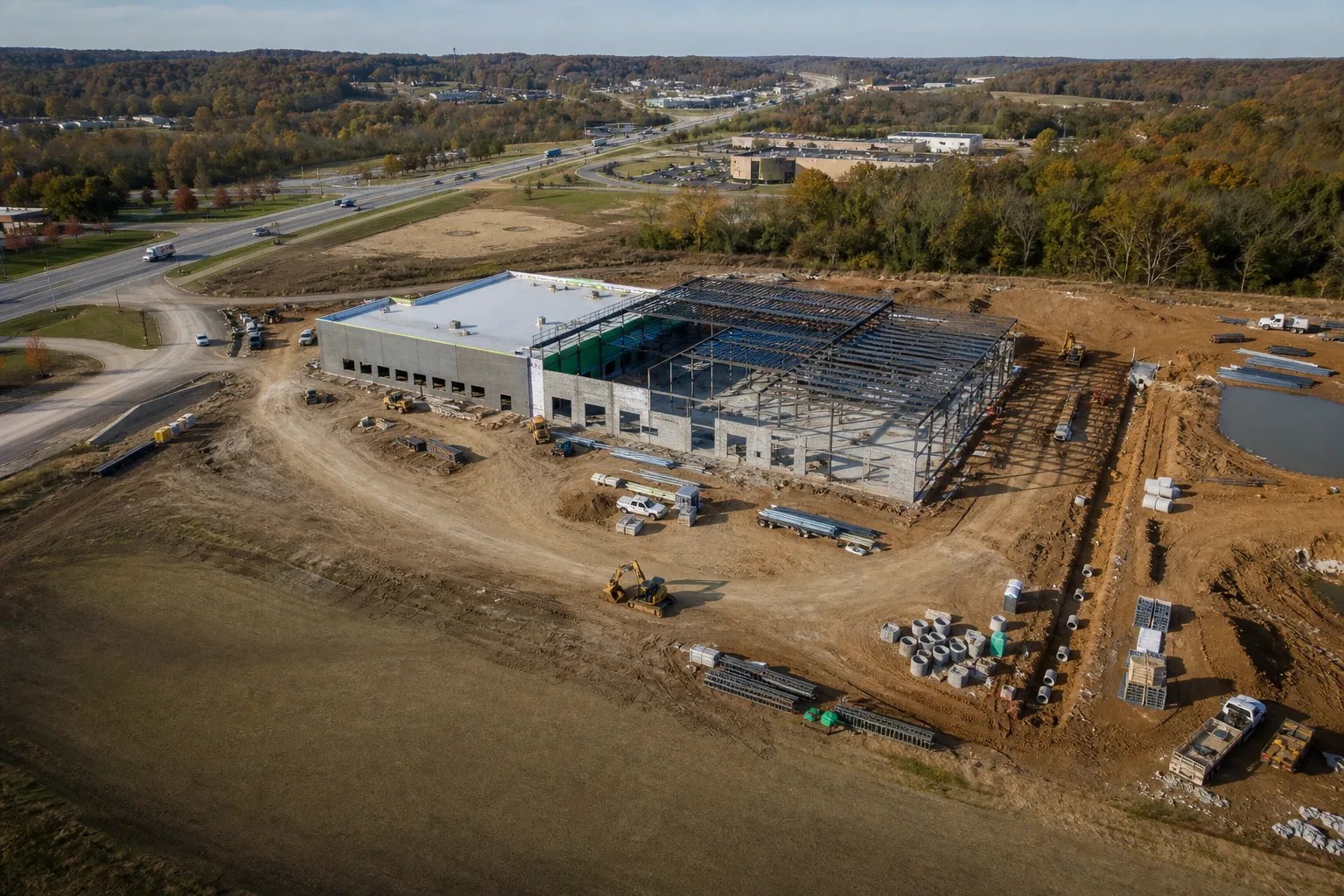
General Contracting Services
Construction Management at Risk in Houston
Four billion dollars of construction was under way at the Texas Medical Center at the time of its most recent published count, across 54 million developed square feet, with a 37-acre mixed-use district called Helix Park planned to reach 5.4 million square feet at build-out. Nobody manages a campus like that on a handshake and a lump-sum bid. Construction management at risk exists for the projects that are complicated, occupied or phased, where the owner needs the builder at the table before the drawings are done.
Under this method, we serve as the owner's construction adviser during design and then commit to a guaranteed maximum price and to building the work. The owner keeps the architect of its choice, sees the cost as the design develops and keeps open books on how the money is spent. The builder shares the risk by taking responsibility for the price.
This page covers how we run construction management at risk in the Houston metro: preconstruction, bidding the trade packages, managing an occupied site, safety, and the schedule realities of a market that builds all year.
Advice first, commitment second
The method works because the builder is paid for advice before it is paid for construction. During design we review drawings for constructability, update the estimate at each milestone, help the owner compare options and test the schedule. When the drawings are far enough along, we convert the estimate into a guaranteed maximum price, backed by trade bids and a defined contingency.
The owner participates in subcontractor selection. We prequalify trades, publish bid packages, level the bids in an open meeting with the owner and recommend awards. The difference between our fee and the cost of the work is transparent, and savings in buyout are shared in the manner the contract states. This transparency is why institutional owners such as hospital systems, school districts and universities often choose the method, a point we explore in our healthcare systems practice.
Phasing around occupied buildings
Many construction management at risk projects take place on campuses that never close. In a dense medical district, where hospital and clinic work is constant, ambulances, patients, researchers, parking and deliveries all share streets with the work, and the construction plan has to respect them. We prepare logistics plans for each phase, with haul routes, crane positions, noise and dust controls, infection control requirements and shutdown windows for utilities.
Redevelopment in older urban areas adds its own wrinkles. In the East End, for example, a phased adaptive reuse of older warehouses, with new facades, storefronts and patios, depends on reuse of existing structures whose condition is only fully known after demolition begins. The method accommodates this by carrying contingency, setting allowances and updating the guaranteed maximum price through defined steps. Our phased construction on occupied sites and renovation and adaptive reuse work apply the same discipline.
The services included
Scope includes preconstruction estimating and scheduling, constructability and value engineering review, procurement strategy, trade prequalification and bidding, a guaranteed maximum price, field management of the work, cost reporting, change control, safety, quality assurance and closeout. Many owners also want us to coordinate permits and utility relationships, which in the Houston area involve the city, the county and in some places a municipal utility district.
We structure the contract to match the owner's needs: early work packages for site, foundations or long-lead equipment, a phased guaranteed maximum price, or a single price for the whole project. Our preconstruction estimating practice provides the numbers, and design-build delivery is available when the owner would rather have the designer on our team.
How the market shapes the method
Houston's institutional and commercial owners are accustomed to this delivery method, and the trade base is deep enough to produce competitive bids. Downtown reported 496 hotel rooms under construction and a headquarters relocation, the Galleria area carries a large inventory of offices and hotel rooms, and the Texas Medical Center keeps expanding.
Competition among subcontractors varies with the cycle. When demand is high, early commitments secure crews and materials; when it softens, buyout savings are available. We track both and advise the owner on timing. Floodplain and drainage rules also shape the method: a structure must sit above the required flood elevation, and that elevation is a design driver that is best discussed before the architect fixes the floor plan.
Safety on a crowded site
Dense urban and campus work raises the stakes. We prepare site-specific safety plans, require subcontractors to do the same, and enforce them daily. Crane lifts over public streets, excavation near utilities and work above occupied floors each require their own plans and permits.
Heat is the Houston factor. We schedule heavy work for the cooler hours, provide water and shade, and train supervisors to recognize heat illness. For healthcare and education owners, we also coordinate with infection control and campus security, and we hold orientation for every worker who enters the site.
Buyout, early packages and the calendar
The calendar benefits from overlapping design and construction. An early foundation or site package can begin before the building design is complete; long-lead equipment can be reserved early. The risk of starting early is that later design changes may affect work already placed, so we make early packages that are stable and defer packages that are not.
We update the schedule monthly and tie it to the cost report, so the owner sees time and money together. Hurricane season is built into the baseline, with weather days and storm protection procedures for open structures.
Describe the program and the campus
Tell us about the program, the campus and the constraints. We will outline how a construction management at risk contract would work for you, what preconstruction would cover and when a guaranteed price could be set.
Common Questions
How does construction management at risk differ from hard-bid general contracting?
In hard bid, a builder prices a finished design in competition. In construction management at risk, the builder is selected earlier on qualifications and fee, and advises during design. The price is guaranteed once the design is far enough along. Owners get more input and earlier cost information.
What is a guaranteed maximum price?
It is a ceiling on the cost of the work plus our fee, set when drawings are sufficiently developed. Savings are shared as the contract states, and the owner has access to all costs. Changes in scope adjust the price through documented change orders.
Can the owner participate in selecting subcontractors?
Yes. We prequalify trades, run bidding, and review the results with the owner before awards. Owners may nominate bidders, subject to qualification standards.
Is the method suitable for smaller projects?
It can be, if there are complexities such as occupancy, phasing or long-lead equipment. For simple projects on clear sites, a lump sum may be more efficient. We advise honestly.
How do you handle an unknown condition in an older building?
We carry a contingency and allowances for the unknowns, investigate early through selective demolition and testing, and update the price as conditions are revealed. The contract defines how this is shared.