
General Contracting Services
Parking Lot Construction in the Houston Area
A parking lot is a drainage structure that happens to carry cars. That is the way we think about it in Houston, where a lot that does not shed water within minutes of a downpour becomes a lake by the time customers arrive, and where a stall count that looked fine on the site plan can force a detention pond bigger than anyone budgeted.
We build new parking lots, expansions, mill-and-overlay rehabilitations and full reconstructions for retail centers, offices, medical campuses, apartments and industrial sites. The scope includes grading and subgrade, base material, asphalt or concrete paving, curbs and gutters, inlets, striping, accessible stalls and routes, wheel stops, signage and site lighting bases. We also coordinate with landscaping and irrigation crews, because trees and planted islands affect both drainage and long-term pavement life.
Owners come to us for new work and for repairs of lots that have outlived their base. The choice between patching, overlay and reconstruction comes down to what is failing, and we try to diagnose it before we price it.
New lot, overlay or rebuild
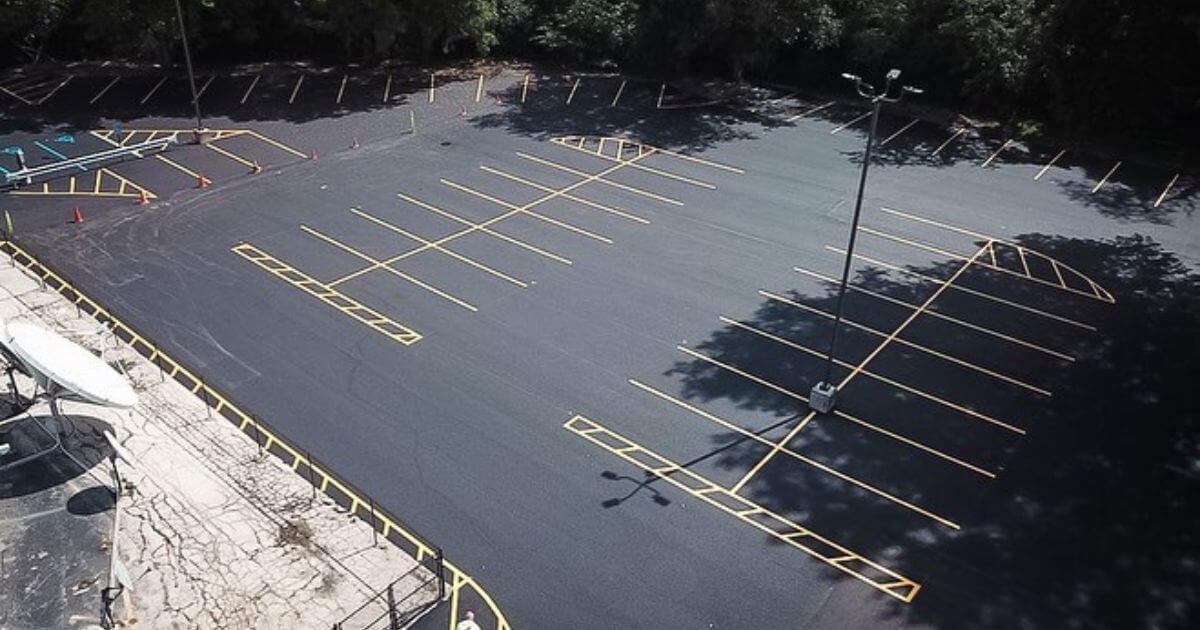
A new lot starts with the subgrade. On clay, it is stabilized and capped with a flexible or stabilized base, tested and proof-rolled before any paving. We then set curbs and inlets, place asphalt in lifts or pour concrete, and finish with striping, signage and accessible-route details. Pavement section is chosen by traffic: car-only stalls need less than a drive lane that sees delivery trucks and refuse collection.
Rehabilitation takes judgment. If the surface is cracked but the base is sound, milling and overlaying can restore the lot at a fraction of the cost of reconstruction. If the base has pumped or settled, patching just buys a few months. We probe, core and survey before recommending the fix, and we price the options in parallel so the owner can see what each buys. Where water is the culprit, we tie the repair to our stormwater and drainage work.
Accessibility, fire lanes and flood rules
Accessible parking is governed by the Texas Accessibility Standards, and projects with an estimated total cost of $50,000 or more must submit construction documents for registration and review with the state's licensing agency. A lot reconstruction can easily cross that line, so the review needs to be on the schedule from the beginning. Slopes at accessible stalls, curb ramps and the route to the entrance are checked in the field, and a few hundredths of a foot of cross-slope can fail an inspection.
Fire lane widths, turning radii and hydrant access are checked against the fire code, which in Harris County is the International Fire Code. Drainage review comes next, and the City of Houston's stormwater guidance now includes a redevelopment credit for sites that already have impervious cover, which can reduce detention for a rebuilt lot. Owners considering a major reconstruction should talk to their engineer about whether the credit changes the math. For the review sequence, see permitting and entitlements.
Lots at the scale of the metro
Parking is a major land use in the Houston area, and it is at the center of many of the largest recent retail and mixed-use projects. The Grand at 249, a $90 million retail center on a 65-acre site at Highway 249 and the Grand Parkway in Tomball, spans 404,256 square feet and was reported as the largest retail concentration in Houston's northwest submarket. A center of that scale requires acres of pavement, a detention system sized to match and a phased construction plan that keeps the first tenants accessible while later phases are built.
In Bridgeland, a master-planned community in the Cypress area, the Houston Texans and Howard Hughes plan an 83-acre Toro District including 22 acres for the team's headquarters, indoor training facilities and practice fields. Facilities with event days and training schedules have parking demands that differ sharply from a typical shopping center, with surges and quiet periods. In denser districts like Uptown and the Galleria, which has approximately 500 acres, 8,400 hotel rooms and over 2,000 companies, surface parking competes with structures and valet, and lot work tends to be fast, night-driven rehabilitation.
Closing stalls without closing the business
A parking lot is usually being used while it is being built or repaired, so the schedule is a traffic plan as much as a construction plan. We break the lot into phases, keep entrances and accessible stalls open, and move work to nights or weekends where tenants require it. Mill-and-overlay work can take an area out of service for a day or two; reconstruction takes longer, and we schedule stalls so the busiest tenants lose the least.
Weather is the other constraint. Asphalt placement needs dry subgrade and suitable temperatures, and in the Gulf Coast rainy season we keep crews flexible and trucks scheduled to match. Concrete lots are less temperature sensitive but need cure time before traffic. When a storm hits, we make sure inlets are protected and temporary striping or barricades keep the public away from open work. These practices are the same ones we use on phased construction on occupied sites.
Who we build lots for
Retail chains and shopping center owners care about visibility, stall counts and speed. Restaurants and pad sites are sensitive to anything that blocks the drive-through. Hospitality groups care about arrival experience, valet queues and covered drop-offs, and about work that does not intrude on guest hours.
Apartment communities and offices tend to want durability and low maintenance, with attention to lighting, accessible routes and drainage at the building entrances. Healthcare campuses want clear wayfinding, short accessible routes and no work that touches ambulance or emergency access. In each case, we start with how the lot is used and ask the owner to tell us when the peaks occur.
Walk the lot with us
Tell us what is failing or what you are planning to build, and we will walk the site, take cores if needed and give you a phased price and schedule.
Common Questions
Is asphalt or concrete better for a commercial lot?
Asphalt is common for car parking because it is quicker and cheaper to install and easy to repair. Concrete lasts longer under heavy loads, such as trash enclosures, drive lanes and truck areas. Many lots use both, assigned by traffic.
How do I know if my lot needs reconstruction?
Look for alligator cracking, ruts, settled areas and water that stays in place. Surface problems can be fixed with overlay; base failure cannot. Cores and a survey tell us which situation you have.
How long will the lot be closed?
Overlay may close a section for a day or two. Reconstruction runs from days to weeks per phase, depending on size and weather. We plan phases so access to entrances and accessible stalls stays open.
Do we need to re-stripe for accessibility when we resurface?
Usually yes. Resurfacing is a good time to confirm stall counts, accessible stall slopes and route widths against the Texas Accessibility Standards. If the project cost reaches the review threshold, documents may need to be submitted before work starts.
Will a new lot require more detention?
Often. Adding impervious cover generally increases the required storage, though a redevelopment credit may offset it in some cases. Your civil engineer will evaluate it, and we price the pond or vault as part of the package.