
General Contracting Services
Deep Drilled Pier Foundations in Houston
Piers are the part of a Houston building that nobody photographs. They go down through clay, water-bearing sand and sometimes layers that look solid until the auger breaks through, and they carry the loads that the soil at the surface cannot. When a building is tall, heavy, or sensitive to movement, a drilled shaft is often the cleanest answer the ground allows.
We construct drilled piers, also called drilled shafts or caissons, as part of commercial and institutional foundation packages. The work includes shaft drilling, casing or slurry support where the hole will not stand, reinforcing cage placement, tremie or pumped concrete placement, and the cap and grade beam work that ties the piers into the structure. Straight shafts, belled shafts and shafts with rock sockets all fall within the same logic: drill, support, inspect, place.
Owners should expect this scope to be one of the more schedule-sensitive on the site, because the work cannot be redone cheaply once the concrete is in. The sections below explain how we reduce that risk, starting with where drilled piers are used in the metro.
Where deep foundations earn their cost
Downtown Houston is a clear example. The district recorded 37.4 million visits in 2024, had 496 hotel rooms under construction, and welcomed the decision by a major energy company to move its global headquarters downtown. Dense urban sites like these have tight footprints, neighbors on every side and heavy column loads, which is the profile that calls for drilled shafts instead of broad spread footings. The same logic applies to garages, hospital towers and the mid-rise projects that rise near the downtown core.
Close to water, piers face a second set of demands. The Brazos River is eroding the land under the U.S. 59 bridge in Sugar Land, and the state transportation department began a $53 million, 38-month project to move the bridge and frontage roads north by 1,000 feet. Scour and bank movement are real design inputs near rivers and bayous, and foundation depth has to account for them. On the coast, storm surge from Hurricane Ike reached an estimated 10 to 15 feet on the west side of Galveston Bay, and deep foundations in Galveston are designed with that history in mind.
Drilling, support and cage placement
Shaft drilling begins with survey layout and a trial of the method on the first shaft. In stable clay a dry hole can be drilled and concreted the same day. Where sand or groundwater is present, the hole needs temporary casing or drilling slurry to keep it open, and the choice of method affects both cost and quality. We discuss the method with the geotechnical engineer before mobilizing, since a mismatch between the assumption in the report and the condition in the hole is the most common source of delay.
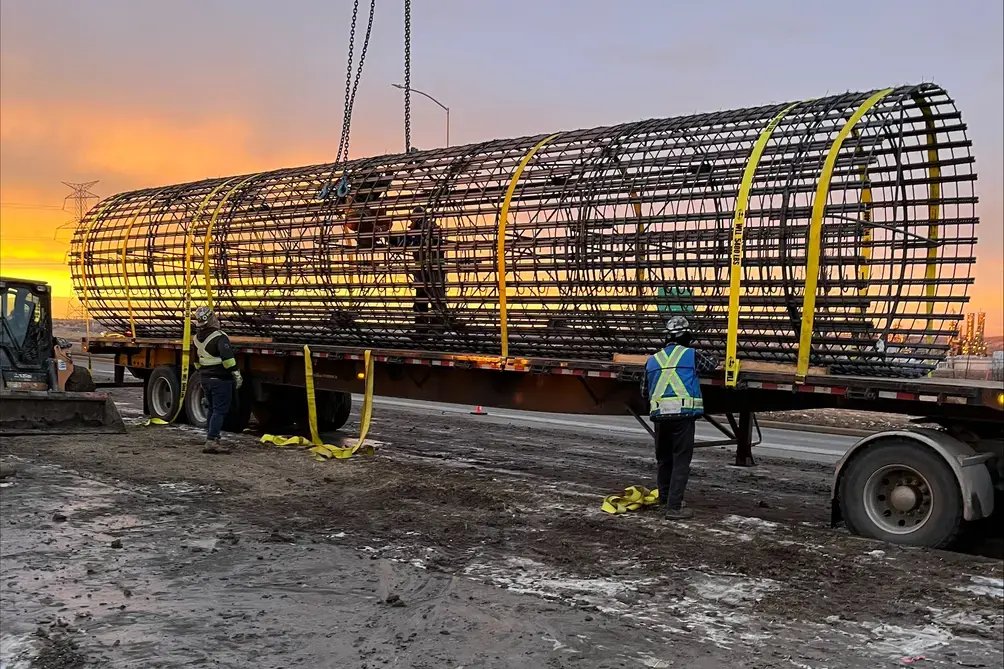
Reinforcing cages are fabricated off-site or on-site, lifted with a crane, and lowered into the shaft with spacers that preserve the cover. Concrete is placed by tremie or pump from the bottom up to avoid segregation, and the top is brought to cutoff elevation with extra material that is chipped back later. Inspectors verify depth, bearing, verticality and cage position, and the records become part of the project file. The cap and grade beam work that follows is the link to concrete foundations generally.
An open hole is a hazard
Open shafts are a fall hazard and a collapse hazard, and the plan for them starts before drilling does. Shafts are covered or fenced when not actively in use, spoil is kept away from the edge, and nobody enters a shaft without an engineered method of protection and a documented entry procedure. Crane lifts of long cages are planned with the rigging, the radius and the ground bearing for the crane pad, because a loaded crane on soft clay is a bigger risk than the hole itself.
Utility strikes are another standing concern. Urban sites often hide old lines, abandoned tanks and unmapped conduits, so we locate and pothole before the rig moves in, and we coordinate with the owner and the utility. Slurry and spoil must be handled in line with environmental rules, which means designated containment, trucks that do not track mud onto public streets, and disposal documentation.
Rig time, concrete and the calendar
A drilling rig is a scarce, expensive machine, and a plan that leaves it waiting on rebar or concrete will cost more than the work itself. We coordinate cage deliveries, ready-mix dispatch and inspection windows so each shaft moves from drilling to placement without a gap. Concrete must be placed within a defined time of drilling to limit sloughing and softening, and we do not drill ahead of what the plant and the crew can place that day.
Weather matters differently here than on flatwork. Rain does not stop a drilling crew, but it does slow trucks, soften the work platform and complicate slurry handling. We build a stable platform of crushed stone or treated soil for the rig and access, and we plan hurricane season with the possibility of a multi-day shutdown in mind. When the piers finish early, the schedule benefits all the trades behind us, and we try to let mass grading and the structure's early packages overlap with the drilling wherever the layout permits.
Work that connects to the piers
Piers support more than buildings. Large equipment pads, canopy foundations, retaining structures and signage frequently use drilled shafts too. For industrial and logistics owners, pier work often accompanies commercial concrete floors when heavy racking or crane loads sit on a slab that needs deeper support at columns.
For healthcare owners and institutions, deep foundations tie directly into medical campus planning, where long runs of construction, noise limits and vibration sensitivity set the pace. Our healthcare systems clients ask for vibration monitoring, haul routes that avoid patient entrances and noise windows that respect clinical hours, and we build those into the drilling plan.
Talk to us before the rig is booked
If your engineer has called for drilled shafts, send the report and structural drawings. We can confirm methods, rig time and a schedule before you commit to a start date.
Common Questions
How deep do drilled piers go in this area?
Depth depends on the load and the soil profile. The geotechnical engineer sets the minimum bearing depth, and what we find in the hole can adjust it. We do not guess; we check the drilled depth and bearing against the log for every shaft.
What if the hole will not stay open?
We switch to temporary casing or slurry, depending on the layer causing the problem. The geotechnical report usually flags wet sands, and we price the method that matches the report. If conditions differ, we stop, notify the engineer and agree on the change before proceeding.
Can piers be installed next to an occupied building?
Yes, with controls. Vibration monitoring, noise limits, dust control and controlled hours are all possible, and the plan is agreed with the building owner beforehand. Drilled shafts are often chosen over driven piles for this reason.
How long does a pier package take?
Production is typically a handful of shafts per rig per day, depending on diameter, depth and ground conditions. A large site takes weeks, a small one days. We give owners a production estimate tied to the number and size of shafts.
Who inspects the shafts?
A special inspector or the geotechnical engineer observes drilling, bottom cleanliness, cage placement and concrete. We keep daily logs, concrete tickets and test results together, and hand the full record over at closeout.