
General Contracting Services
Mass Grading and Site Prep in the Houston Area
A clay soil that cracks one-to-five centimeters wide in a dry August and then swells shut in a wet October does not behave like a dirt pad, and the grading plan has to be written with that in mind. The coastal-prairie clays west and south of town are the reason mass grading around Houston is less about moving the most dirt and more about deciding where the dirt goes, how wet it is when it moves, and what it will do after the building is on it.
We handle mass grading as the first real commitment on a pad, because every later trade inherits whatever the earthwork leaves behind. Stripping, cut and fill, proof-rolling, lime or cement treatment, and the final fine grade are one chain, and a weak link shows up months later as a heaving slab or a ponded truck court. Our job is to build that chain around the weather and the drainage review, not around the equipment on hand.
Owners, especially commercial real estate developers holding land for later phases, come to us with raw tracts, former farm fields, cleared pine land and old industrial parcels, and they usually ask the same question: how many weeks until the pad is ready for foundations? The honest answer is a range with the conditions behind it, and the rest of this page explains how we arrive at it. If detention, utilities and paving come with the same tract, our site development and utilities work picks up where the pad leaves off.
What the earthwork package covers
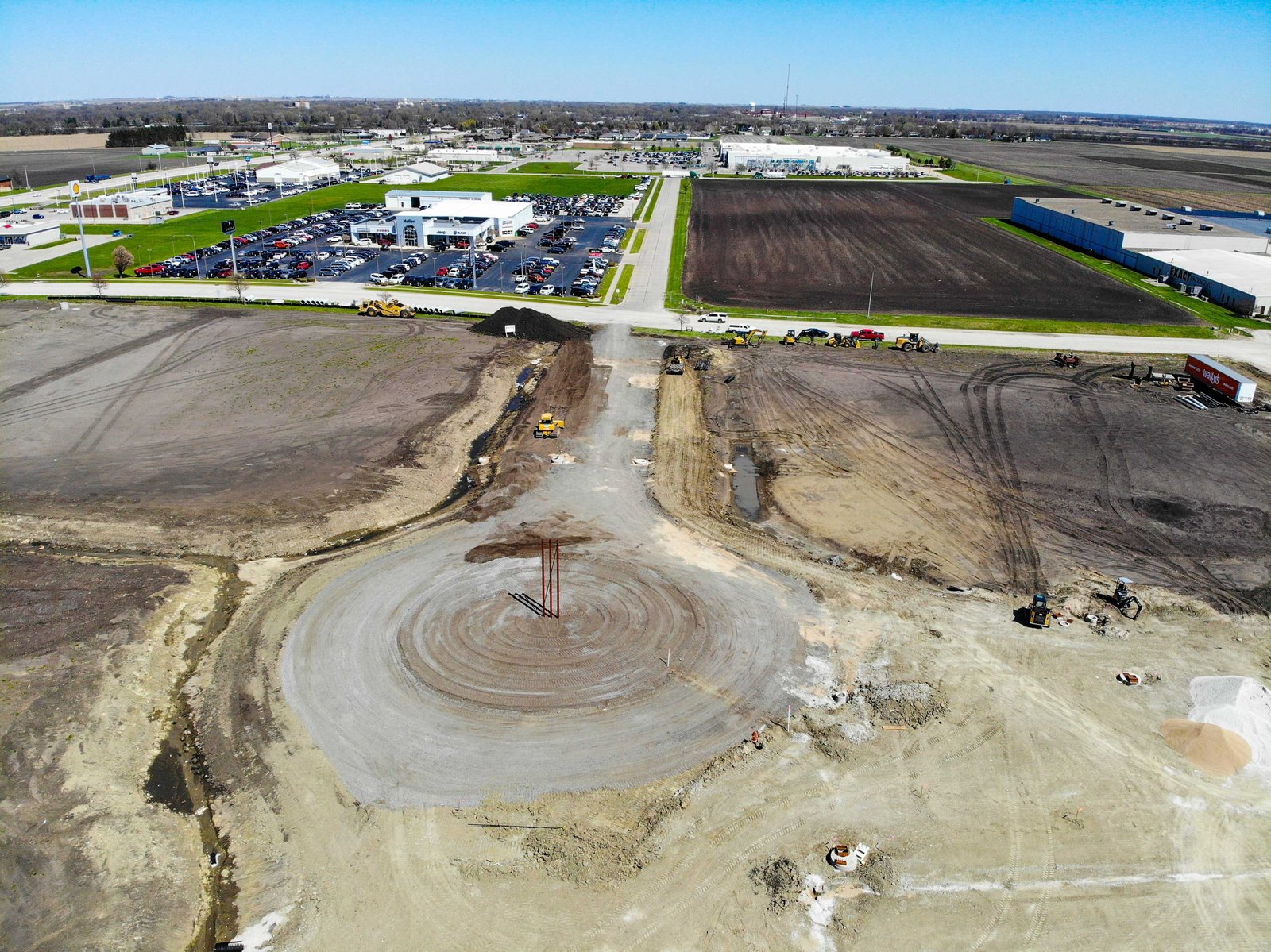
We start with clearing and stripping, with topsoil stockpiled where the drainage plan allows and hauled where it does not. Organic material and tree roots come out before anything is placed, because buried organics are the cheapest way to buy a settlement problem. Then comes the cut-and-fill balance: we want the site to export or import as little as possible, since trucking is the line item that moves most when haul distances grow or a road gets closed by rain.
Fill goes down in lifts at controlled moisture, compacted and tested before the next lift. On clay that is rarely as simple as it sounds. Too dry and the material will not knit together, too wet and it pumps under the roller. Where the soil will not cooperate we treat it with lime or cement, mix it in place, and let it cure, which turns a sticky subgrade into a working platform for the building pad, the truck court and the haul roads that follow. The package ends with finish grade to the tolerances the slab, the paving and the storm design require.
Gumbo, cracks and the floodplain line
The soil series described for the coastal prairie in Fort Bend County near Guy is a useful picture of what we are dealing with: very deep, very slowly permeable clay with 45 to 60 percent clay content, cracks that open at least 12 inches deep when dry and stay open for 60 to 90 cumulative days in most years, and slickensides where blocks of soil have slid against each other. That is the ground under a lot of Rosenberg and Richmond and the Brazos-bottom tracts. It drains slowly, it shrinks and swells, and it is the reason geotechnical reports on those sites read like warnings.
The second constraint is where the water goes when the pad is built higher than the ground around it. Raising a site changes the neighbor's drainage and, in a mapped floodplain, may be restricted outright. We read the floodplain and detention requirements before we finalize elevations, so the grading plan and the stormwater plan agree. Our stormwater and drainage scope includes the ponds and outfalls that this grading feeds, and the two scopes are scheduled against each other from the first week.
Pour windows start with the dirt
Earthwork is the trade most exposed to hurricane season. A three-inch rain on an open cut can erase a week of compaction, and the schedule has to carry that risk honestly. We sequence the work in sections so that a finished lift can be sealed with a smooth-drum roller before a storm, and we keep temporary swales and sediment controls ahead of the face of the work rather than behind it.
At the Mainline Texas Industrial Park, Union Pacific is developing 2,040 acres in Rosenberg's extraterritorial jurisdiction, about 38 miles southwest of downtown Houston, with roughly 1,300 acres of rail-served land and up to 20 million square feet of potential development. Sites that size are graded in phases, and a phase boundary needs to be a drainage boundary too, so each finished area can shed water on its own while the next one is still open. The rail, US 90, Highway 36 and Interstate 69 access also shape haul routes, which is why we map the trucking before we price the cut.
Where grading budgets drift
Four variables decide the number: the volume of import or export, the haul distance, the soil treatment, and the number of rain days the schedule absorbs. Import fill is the most volatile of these, and the cost of a pad can swing sharply depending on whether suitable material is available nearby or must come from a distant pit. We carry an allowance for treatment on clay sites and tell owners plainly when the geotechnical report suggests it will be used.
Owners can reduce the drift by sharing the geotechnical report and the drainage plan before we bid, and by agreeing on the pad elevation early. A foot of added elevation can mean thousands of additional yards. If your project is a warehouse shell on a new tract, a conversation with our preconstruction estimating group usually turns up the balance point between a higher pad and a larger pond, and it tends to be worth having before the survey is final.
Equipment and people on the pad
We keep earthwork close because it is the part of the job where a bad day cannot be handed to somebody else. The grading crews we supervise run the dozers, scrapers, motor graders and compaction equipment that a mass-grading package needs, and they work with a testing agency on density and moisture rather than trusting appearance. Proof-rolling is done with a loaded truck, and soft spots are cut out and replaced rather than skimmed over.
The same crews carry the work into the next trade. Fine grading for a tilt-up or steel building, trimming for concrete foundations, and subgrade for parking lot construction all use the same surveyed benchmarks, which keeps the elevations consistent from the pad to the pavement edge. For industrial owners, that continuity matters on warehouse sites, where a quarter-inch of slab flatness depends on a subgrade that was finished once and left alone.
Send us the geotechnical report
Bring us the survey, the geotechnical report and the drainage plan, and we will tell you what the pad will take, how the weather changes the schedule, and what we would do differently. Call or send the tract and we will set up a site walk.
Common Questions
How long does a typical commercial pad take to grade?
It depends on tract size, soil treatment and rain, but a plain answer is weeks for a modest pad and months for a multi-building site. We give owners a range tied to the number of dry working days we expect, and we show which activities can run in parallel. Treated clay needs curing time that cannot be rushed, so we schedule it early.
Do we need lime or cement treatment on clay soils?
Often yes, but only the geotechnical report can say how much. Treatment gives a stable working surface and reduces the shrink-swell movement under slabs and paving. We recommend a test section when the soil data is thin, because it is cheaper to find out on a small area than on the whole pad.
Can the pad be raised to get above the floodplain?
Sometimes, but not everywhere. City of Houston standards and Harris County regulations restrict fill in mapped floodplains and require storage to be offset where fill is allowed, so the answer depends on the exact parcel. We review the mapping with your engineer before locking the elevation, so the grading plan does not need to be redrawn after permit review.
What happens to the schedule when it rains?
Open lifts get sealed and protected, and the crew moves to work that is not weather sensitive, such as utilities or sediment control. Compaction resumes when moisture is back in range. We carry weather days as a stated assumption in the schedule so a wet month does not come as a surprise.
Who tests the compaction?
An independent testing agency, working to the geotechnical engineer's specification, takes density and moisture readings on each lift. Our superintendent reviews the results daily and stops work on a lift that fails. Owners receive the test log as part of closeout.