
General Contracting Services
Truck Courts and Dock Aprons in Houston
Landing gear punches through weak pavement, and it does so on the one day a loaded trailer sits in the same stall for three days. The truck court is the part of an industrial site that takes the harshest loading of anything built outside the building: heavy axles turning on a fixed radius, trailers parked on small steel pads, and diesel and hydraulic fluid dripping onto the surface for years.
We build truck courts, dock aprons, trailer parking, drive aisles and the concrete dolly pads that go with them. In the Houston market, nearly all of that work is rigid pavement, because asphalt over soft clay ruts under standing trailers and softens in August. The key decisions are slab thickness, reinforcement, joint layout, subgrade treatment and drainage, and they are made once, in the design stage, at a cost that is small compared with the cost of ripping out a failed apron.
Owners of distribution, cross-dock and manufacturing buildings usually ask first about price per square foot. We try to move the conversation toward life-cycle cost, because the court is the part of the property that tenants notice when it fails and that landlords pay to fix.
Courts for different kinds of freight
A cross-dock terminal is the most demanding case. Trailers move constantly, dock doors are used at both sides, and the court must handle the turning loads of tractors with no time to rest. Our truck terminal and cross-dock work often calls for thicker slabs, doweled joints and a wide, heavily reinforced approach zone. A motor freight service center like the Old Dominion facility on 25 acres in Conroe Park North is a good example of the type, a site where the pavement is the product.
Warehouse and distribution sites with fewer truck moves per door can use a lighter section in the parking stalls and a heavier one in the maneuvering zone. Manufacturing plants with outbound trailers sit somewhere in the middle. We help owners set zones by traffic, not by uniform specification, which keeps the budget focused on the concrete that will work the hardest. For a conventional warehouse, that zoning is often the largest saving available.
From base course to sealed joints
The work starts with grading and subgrade preparation, and on clay that means treatment or a thick granular base, proof-rolled and graded to the drainage pattern. Forms or slipform equipment follow, along with dowel baskets at construction joints and reinforcement where the design calls for it. Concrete is placed in lanes, finished with a broom or tined surface for traction, cured and sawn.
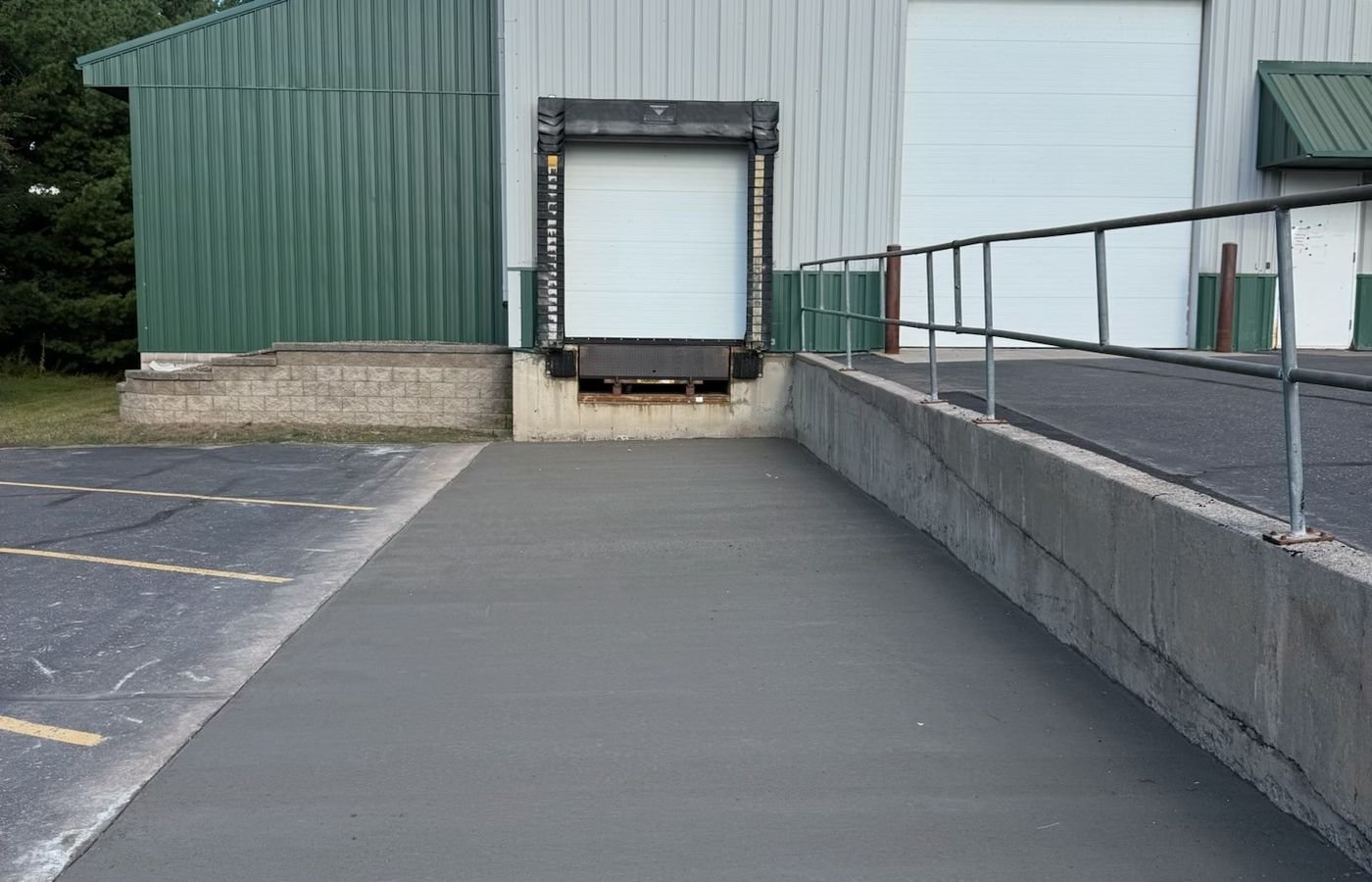
Details separate good courts from adequate ones. Dock aprons slope away from the building at a rate that keeps water out of the doors but does not make trailers creep. Dolly pads are thickened and reinforced to take the point load of landing gear. Bollards, wheel stops, light pole bases, guard rail and trench drains are built in before paving rather than coring through the slab later. Joints are sealed after curing, because open joints let water into the base and invite pumping.
Drainage, rail and the ground underneath
Truck courts are large impervious areas that generate a lot of runoff, and they often determine the size of the detention pond. The grades must carry water to inlets without puddling at dock doors, and they must do it without the long slopes that make trailers hard to level. We coordinate with the civil engineer and with the stormwater and drainage trade partners so the inlets, trench drains and aprons are set to the same control.
Rail and port adjacency add their own considerations. The Houston area's industrial parks are built around freight infrastructure: the Bayport Container Terminal complex includes a 123-acre intermodal facility, and in Conroe BNSF handles east-west shipping while Union Pacific handles north-south freight. Sites near Conroe Park North or the port have container drayage, heavy loaded chassis and, in some cases, rail spurs that cross the truck court. Where a rail crossing is involved, the pavement section, the track panel and the grade transition must work together.
Managing the court
We schedule and supervise the concrete on most truck courts, from forming through finishing. Paving large areas rewards continuity: a crew that moves lane by lane through a court keeps joints aligned, finishes consistent and surface texture uniform. We use laser-guided equipment for grade, and we survey as-built elevations so owners have a record of the final slopes.
The crew that builds the court also understands what the building above it needs. We coordinate with the floor crews so the dock leveler pit, the apron slab and the interior slab meet at the correct elevations, an item that links this scope to commercial concrete floors. On projects for logistics and distribution owners, that coordination is a regular source of rework avoided.
Where we pave across the metro
Truck courts are built wherever the industrial market goes, from the Houston Ship Channel and Port of Houston area to the northern corridors, the Grand Parkway clusters and the southwest rail park near Rosenberg. Each submarket has different soils, different drainage authorities and different tenant expectations, and we plan accordingly.
If your site is near the port, start with our Port Houston and Bayport page. For sites on the north side, the Conroe Park North page describes the corridor. In each case, the first step is a site walk and a review of the geotechnical report and civil drawings.
Price the court with the building
Share the site plan and the truck traffic count, and we will build up the pavement section, the joint layout and the price with options.
Common Questions
Should the truck court be concrete or asphalt?
For standing trailers and heavy turning loads, concrete is the better choice in this market, because asphalt softens in summer heat and ruts under landing gear. Asphalt can work in light-traffic parking areas. We often combine them by zone.
How thick should the apron be?
Thickness is set by the engineer based on traffic, subgrade and design life. We do not offer a standard number because the right answer depends on the soil and the truck counts. We do suggest the engineer evaluate the maneuvering zone separately from the parking stalls.
Why do joints matter so much?
Joints control where the concrete cracks and how loads transfer across the slab. Doweled joints carry the load across; poorly spaced or unsealed joints let slabs rock and water enter. A good layout and timely sawing are among the cheapest ways to extend pavement life.
Can you work while the facility is operating?
Yes, in phases. We close sections, route trucks around them, and place concrete in lanes that can reopen when strength is reached. The plan depends on how many doors must remain in service, and it is shared with the tenant before work begins.
What causes truck court failures here?
Common causes are poor subgrade preparation, undersized sections, water entering through open joints and inadequate drainage. Landing gear damage is common where dolly pads are missing. Most failures are traceable to a decision made before paving.