
General Contracting Services
Commercial and Industrial Demolition in Houston
Before anything comes down, something has to be switched off. Gas lines get capped at the main, electrical service gets cut at the pole, water and sewer get isolated, tanks get emptied and tagged, and every tenant, neighbor and utility gets told. Demolition looks like the loud, quick part of a project, but the decisions that determine whether it goes well are made weeks before the first excavator arrives.
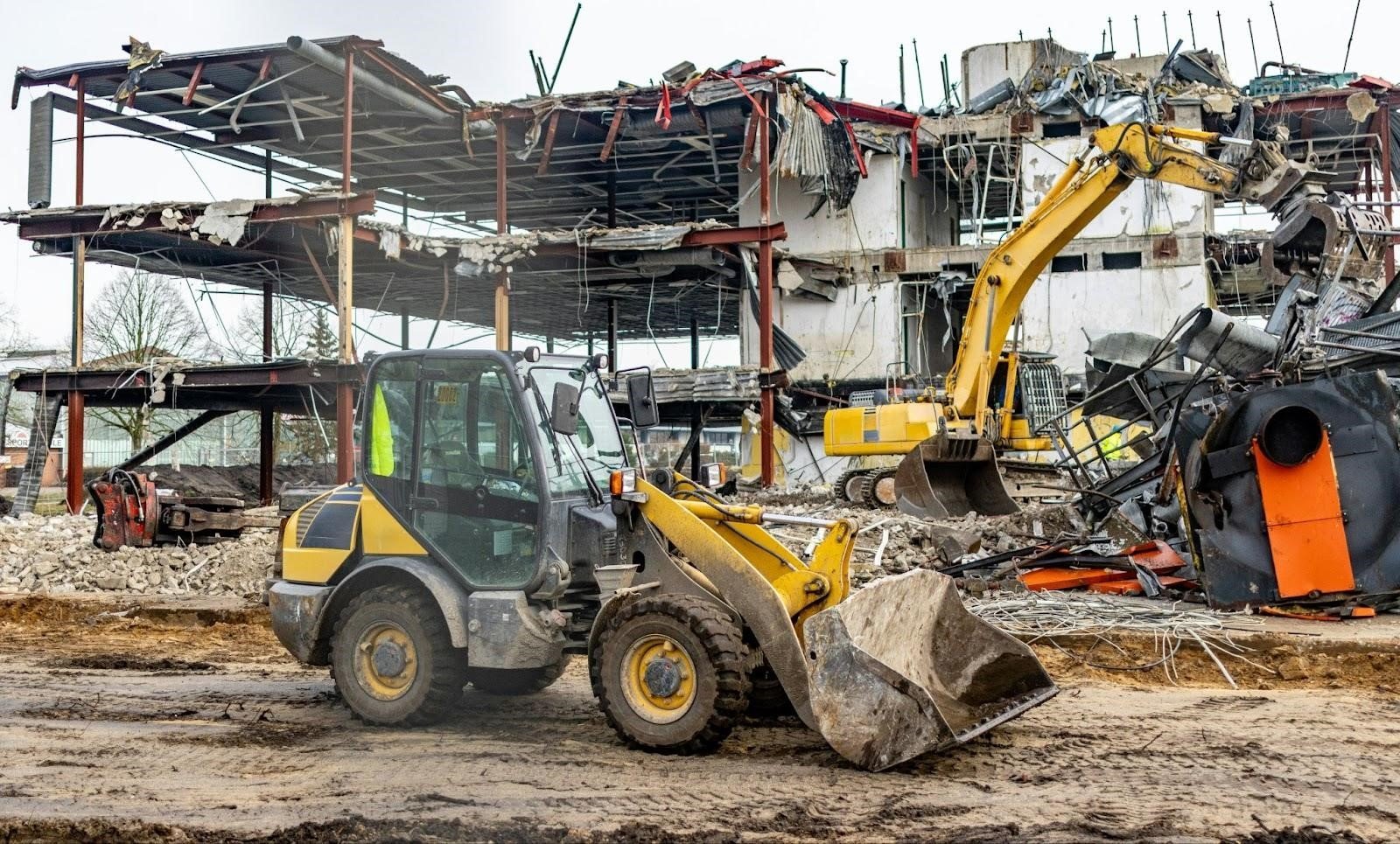
We perform selective and full demolition of commercial, industrial and institutional buildings around Houston, along with the site clearing, slab and foundation removal, utility abandonment and debris management that go with it. The work covers warehouses and light industrial buildings, aging offices, retail centers, hotels, school buildings and the structures left behind when a plant or a tenant leaves. We also do interior demolition for renovations, where the challenge is to take out exactly what the drawings say and nothing else.
Owners call us when they have a parcel to redevelop, a building they cannot occupy, a lender that wants a cleared site or a landlord that needs a space stripped to the shell. In each case, the outcome they want is a clean, graded site or a clean, safe shell with documents that show it was done correctly.
Selective, structural and total
Selective demolition removes defined parts of a building: interior partitions, ceilings, floors, mechanical systems or sections of structure. It is common in renovation and adaptive reuse work and tenant buildouts, and its main risk is damaging what stays. We mark limits, protect adjacent work, shore where needed and use saws, cores and hand tools where the area is delicate. Structural demolition removes frames, walls and slabs, usually with excavators equipped with shears, crushers and hammers, along with sequencing that keeps the structure stable at each stage.
Total demolition adds site work: foundation and slab removal, grade beam and pier removal where required, utility abandonment, backfill with approved material and final grading. We separate debris by type on site where the contract calls for recycling, crushing concrete for reuse as base where permitted and hauling the rest to approved facilities. When the site becomes a new project, the same crews can continue into mass grading so the owner deals with a single contractor from standing building to ready pad.
Dust, hazmat and the neighbors
Demolition safety starts with a survey. Asbestos-containing materials, lead-based paint, PCBs in old ballasts, mercury in switches and refrigerants in old equipment all require identification and licensed abatement before demolition begins. We rely on the owner's or an independent consultant's survey and verify that notifications to regulators are made on time and that abatement is complete before we start.
During the work, dust control is a daily task. Water is applied to the structure and the debris, haul routes are swept and wheel washes keep mud off public roads. Hearing and respiratory protection, exclusion zones and spotters guard workers and the public. Neighboring buildings are monitored for vibration where required, and we photograph and document their condition before we start. Hurricane season adds its own rule: no half-demolished structure is left standing when high winds are forecast.
Notices, permits and utility abandonment
Demolition requires permits and notices that vary by jurisdiction. In the City of Houston, demolition work is reviewed through the city's permitting system, and in other cities and in unincorporated areas the process differs. Utility disconnects must be confirmed in writing by each provider, and regulators expect asbestos notifications ahead of work. The schedule must include time for each step, and the permit set should be assembled before the contract date, not after.
When a site is in the floodplain, demolition and the subsequent redevelopment can come under floodplain permitting. The Houston Permitting Center's Floodplain Management Office issues permits for construction in the 500-year floodplain, 100-year floodplain and floodway under Chapter 19, and the redevelopment may be required to meet the 2-foot margin above the 500-year elevation. Knowing that before clearing begins helps owners decide how the cleared site will be graded and drained, a topic we cover under site development and utilities.
What lies under old Houston sites
Industrial districts along the Houston Ship Channel have layers of history. Chevron completed a retrofit of its Pasadena refinery in late 2024 that raised capacity by nearly 15 percent to 125,000 barrels per day, a reminder that facilities in this district are constantly being rebuilt, expanded and retired, and that the parcels around them have been used for industry for a long time. Beltway-225 Business Park in Pasadena, an industrial project fronting Beltway 8, shows the other side of that cycle: land cleared and redeveloped into newer buildings in phases. The Ship Channel and Pasadena market gives us regular exposure to that pattern.
Oil field history can matter too. Humble's city history records that shallow oil production there began in 1902, and that by 1905 the Humble field was the largest producing field in Texas, while Tomball became a boomtown in 1933 when drillers struck oil west of town. We do not assume anything about a particular parcel from the history of its area, but we do recommend that owners in such districts complete environmental due diligence, including a review of abandoned wells, tanks and buried pipelines, before demolition and redevelopment. If something is found, work stops and the owner decides how to proceed.
What demolition costs, and what it returns
Demolition pricing depends on building size and construction type, hazardous materials, access, the distance to disposal and recycling facilities, and the extent of below-grade work. Slabs and foundations often cost more to remove than owners expect, and deep foundations, tanks and utilities can add significant cost. Salvage and recycling can offset some of it: steel and other metals have scrap value, and crushed concrete can be reused as fill or base.
We prepare a unit-price breakdown for items that cannot be known in advance, such as the removal of unforeseen buried structures, so changes are priced by agreement and not by argument. For manufacturing owners closing a plant, or developers clearing a warehouse site for a new building, we also coordinate disposal paperwork, so that the records support later transactions.
Tell us what is coming down
Send the address, the building description and any surveys you already have. We will review the site, outline the sequence and give you a price with the unknowns identified.
Common Questions
What has to be done before demolition begins?
Utilities must be disconnected and confirmed, hazardous materials surveyed and abated, permits and notices issued, and neighbors informed. We also photograph adjacent properties. The checklist is detailed, and we share it with the owner.
How long does a commercial demolition take?
A small building may come down in days, while a large one takes weeks, plus the time for abatement and permits. Foundation removal and site grading extend the schedule. We give a plan once we have seen the building and the survey.
Can concrete from the building be reused?
Often, if the contract and the site allow. Concrete can be crushed and reused as base or fill after metal is removed. This reduces hauling and disposal costs, and we confirm quality requirements with the engineer.
What if we find buried tanks or old pipelines?
We stop work in that area, notify the owner and bring in qualified specialists to evaluate. Depending on what it is, removal or closure follows regulatory procedures. Unit prices set in advance keep changes from becoming disputes.
Do you demolish only the building, or also the slab and foundation?
Either, depending on the contract. Many redevelopments require removal of slabs and foundations, utility abandonment and grading. We price those items separately so the owner can choose.